

Frederick Douglass: First Edition Narrative of the Life of Frederick Douglass
Frederick Douglass: The first edition of the “Narrative of the Life of Frederick Douglass, An American Slave...”
Impact on Abolitionist Literature, the 1845 First Edition
Published in 1845, the first edition of Frederick Douglass’s Narrative of the Life of Frederick Douglass, An American Slave. Written by Himself, quickly became a cornerstone in abolitionist literature. The Narrative was the first of three autobiographies written during the life of Frederick Douglass with this edition being of enormous publicity value for anti-slavery activists —Frederick Douglass among them—in their fight against slavery. This first autobiographical ‘installment’ covered the life of Frederick Douglass from childhood to self-liberation. Douglass's narrative challenged societal norms and inspired change. Beyond its value as a well-written book, the Narrative of the Life of Frederick Douglass was held in high value for its worth as a strong symbol of the broader struggle for freedom and the moral critique of slavery. In Douglass's narrative, the price of freedom and the worth of knowledge were inextricably linked.
From Bondage to Freedom: Douglass's Journey and Pursuit of Education
Born around 1818 into the bonds of slavery, Frederick Douglass recognized the intrinsic worth of education as a means of liberation. His clandestine pursuit of knowledge carried a price, both in terms of personal risk and societal consequences. Following Douglass’s successful self-liberation, the triumphant publication of his first Narrative in 1845 clearly demonstrated that an enslaved African American could reach an advanced level of education and writing fluency. Among the prevailing stereotypes of the mid-19th century, such an idea was a novel one, and the first edition of Douglass’s Narrative sold exceptionally well to a public curious to learn about the life of an “American Slave.”
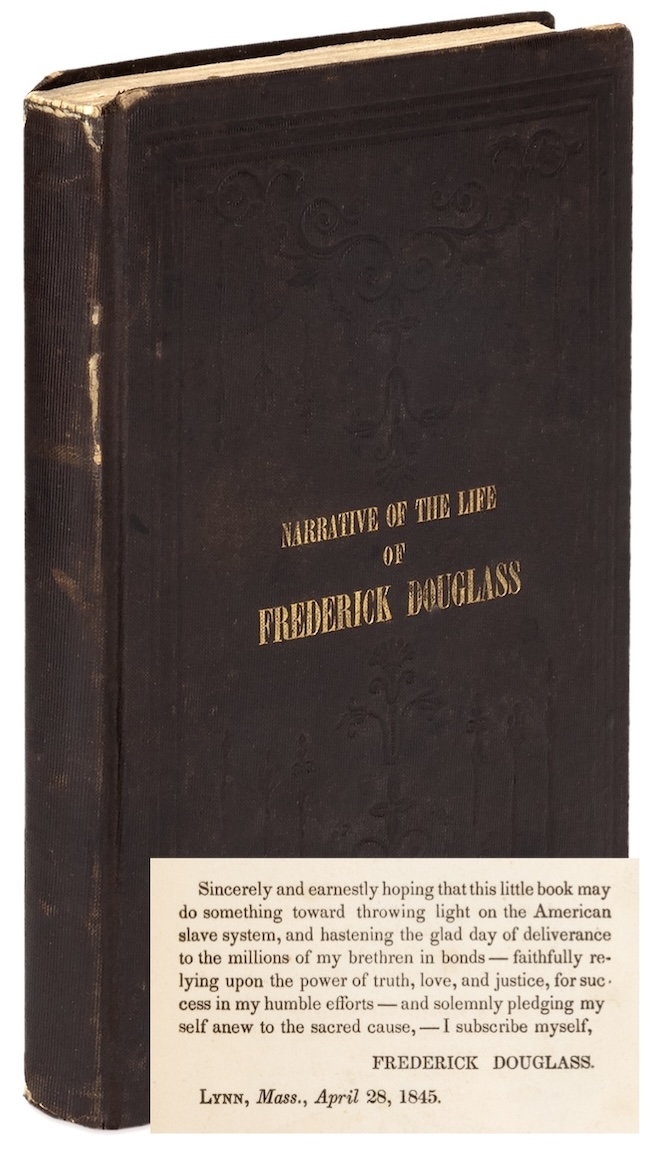
The original binding for the first edition, the publisher’s brown cloth, gilt-lettered and embossed in binding.
The Portrait Frontispiece in Douglass's First Edition
The success of the first edition of the Narrative was aided by its portrait frontispiece of Frederick Douglass, considered one of the early depictions of educated African Americans during the mid-19th century. The portrait portrays Douglass as a well-dressed and articulate figure, and it stands as a noteworthy representation of Douglass as an intellectual and educated individual, challenging prevailing stereotypes of enslaved individuals. This visual element helped to cement Douglass's status as a pioneering figure in the fight against slavery and his commitment to education.

The famous portrait of Douglasas that would help to catapult him to the national stage.
Subsequent Editions of Douglass's Narrative
Published in Boston, “at the Anti-Slavery Office,” the 1845 first edition of Douglass's narrative was quickly followed by further editions in the 1840s, issued between 1846 to 1849. While the first edition is prized by rare book collectors today as a classic of African American history, these subsequent editions are well worth collecting. Not only have these later editions become as rare as the first edition, but there are also subtle nuances and changes from one edition to the next that the savvy rare book collector will discern and appreciate through their comparison.
Our current inventory of books written
by or about Frederick Douglass can be found here.