Login | Cart

Ian Brabner, Rare Americana, LLC

Ian Brabner, Rare Americana, LLC

Main Navigation

Toggle main navigation
  • Browse
    • Africa
      African American Writers
      African-American History
      African-American Slavery
      American Broadsides
      American Civil War
      American Enterprise
      American Law
      American Medicine
      American Presidents
      American West
      Art & Graphics
      Boston
      California
      Chicago
      Children's Books
      Civil Rights
      Delaware
      Fiction & Poetry
      Florida
      Food & Drink
      Georgia
      Health and Hygiene
      History of Education
      Labor
      Maps
      Maryland
      Massachusetts
      Military
      Mississippi
      Music & Musicians
      Native Americans
      New Jersey
      New York City
      New York State
      North Carolina
      Ohio
      Pennsylvania
      Philadelphia
      Photography
      Railroad
      Reconstruction Era
      Religion in America
      Science and Technology
      Social Reform
      South Carolina
      Texas
      Theatre & Amusements
      Trade Catalogs
      Travel
      Varia
      Virginia
      Washington DC
      Women's History & Women Writers
      World War I & II
      Browse All Categories
      Recent Acquisitions
  • Browse Mobile
    • Recent Acquisitions
    • Africa
    • African American Writers
    • African-American History
    • African-American Slavery
    • American Broadsides
    • American Civil War
    • American Enterprise
    • American Law
    • American Medicine
    • American Presidents
    • Art & Graphics
    • Boston
    • California
    • Chicago
    • Children's Books
    • Connecticut
    • Delaware
    • Fiction & Poetry
    • Food & Drink
    • History of Education
    • Indigenous Peoples
    • Maps
    • Maryland
    • Massachusetts
    • Military
    • Music & Musicians
    • New Jersey
    • New York City
    • New York State
    • Pennsylvania
    • Philadelphia
    • Photography
    • Reconstruction Era
    • Religion in America
    • Science and Technology
    • Social Reform
    • South Carolina
    • Theatre & Amusements
    • Trade Catalogs
    • Travel
    • Varia
    • Virginia
    • Washington DC
    • Women's History & Women Writers
    • World War I & II
  • Catalogs
    • Catalogs & Lists
    • For Collectors
    • Recent Acquisitions
  • Sell to Us
  • About
  • Contact
Advanced Search
Building the Statue of Liberty: Liberty Enlightens the World

Building the Statue of Liberty: Liberty Enlightens the World

A powerful international symbol of opportunity, freedom, and political liberty, how did the Statue of Liberty first achieve its iconic status?

In the early decades of the 19th century, as America’s colonial and revolutionary heroes were passing away, Americans began to write histories of the young Republic. Joining these words were powerful images of America’s past like Plymouth Rock, the allegorical figure of Columbia, and the Liberty Bell. At the time of the Civil War, Thomas Crawford’s sculpture Freedom Triumphant in War and Peace, as it was then called, was set atop the dome of the Capitol in Washington.

Visual Americana, whether as illustrations, prints, engravings, or graphic designs, took up these these powerful symbols. It transformed them into icons, but they remained rooted in our own history, our own past.


Building a Statue of Liberty. What are the first printed images of “Lady Liberty” to enter the iconography of America? First, events in France got the ball rolling… 

Americans, however, are not people of the past! We are people of frontiers, new inventions, travel—people of the future. Immigrants flocked to America attracted by the mere hope of opportunity. America needed a new, international, “rock-star-famous” kind of symbol and we sure got one thanks to French sculptor Frédéric Auguste Bartholdi.

Bartholdi’s colossal sculpture, Liberty Enlightening the World, is better known to us as the Statue of Liberty. It was formally dedicated in New York City’s harbor on October 28, 1886. However, it was born as an icon not in copper, iron, and steel, but first on paper! Bartholdi patented his design for the Statue of Liberty on February 18, 1879. The patent includes a drawing of the statue as we know it.

Before this, however, in 1875, at least two other images of this same familiar image of the Statue of Liberty appeared in print. Here they are:

Among the items in this unique collection, a rare historical broadside and subscription card were published in 1875 by the Union Franco-Américaine.  

These rare items—an illustrated broadside, a photographically-illustrated subscription card, a lottery ticket, a color print—were solicitations for money to erect the Statue of Liberty. Each depict the statue on its familiar pedestal on Bedloe’s Island in New York City’s harbor. Although Bartholdi favored it, Bedloe’s Island had not even then been formally selected as the site for the completed monument.

These images are literally foundational.

The two images of the statue on the broadside and on the card are different from each other. Interestingly, the image on the card has been reproduced photographically and may well have been taken directly from the artist’s original drawing. Together, these two images may well depict the earliest known printed views of the Statue of Liberty. This is the birth of an icon.
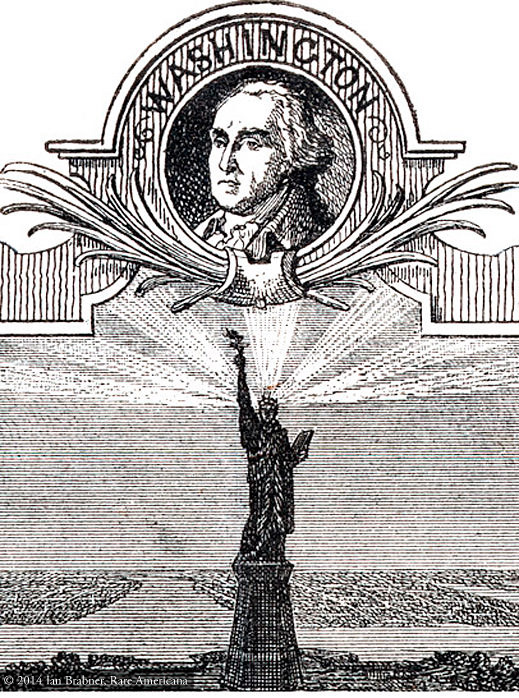
George Washington, already himself an American icon, surmounts this rare image of the Statue of Liberty.
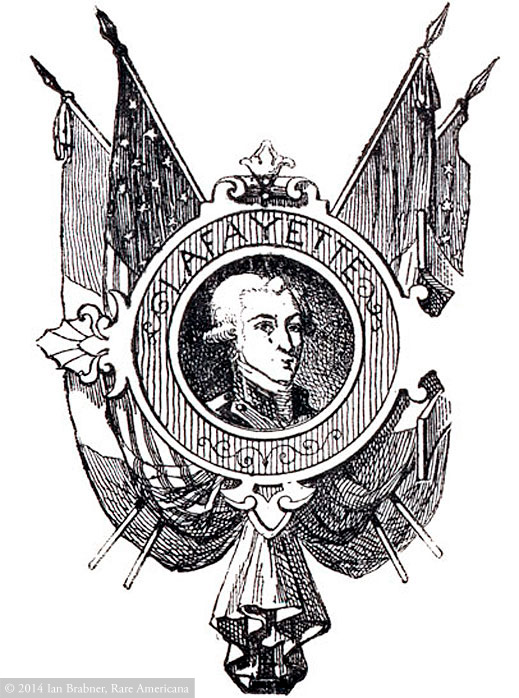
An honorary American citizen, Lafayette remains a popular symbol of Franco-American friendship.
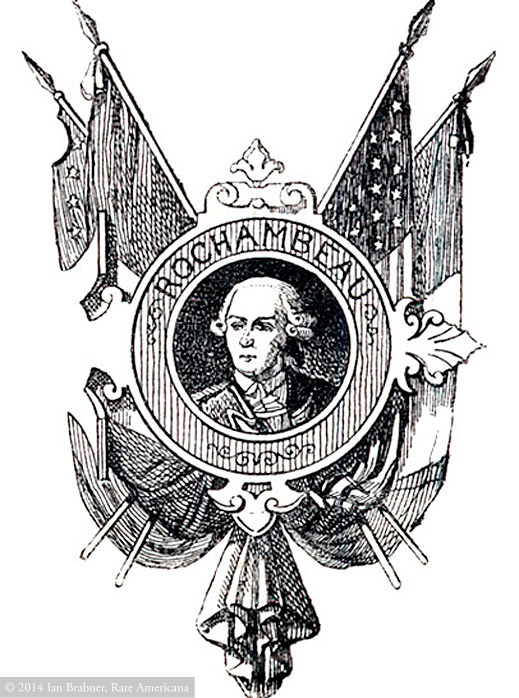
The Comte de Rochambeau, another French hero of the American Revolution, has recently been recognized.
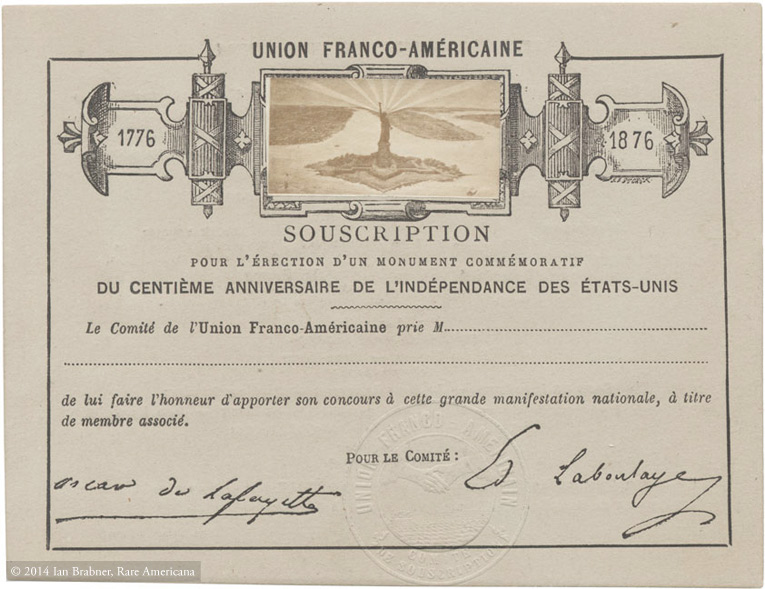
 

The use of actual photographs as illustrations on ephemera is unusual. Ironically, subscription cards like this typically survive only when they have not been used. If it had been returned with a contribution, it would likely have been recorded and then discarded.  
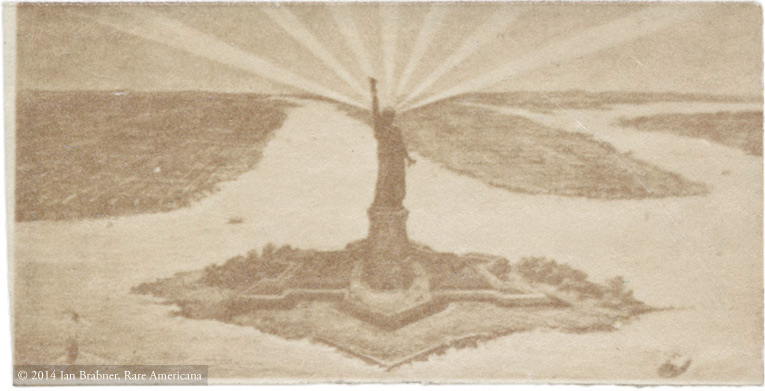
A closer look. The visual iconography of New York City includes this rare 1875 photographic image of a drawing of the Statue of Liberty. Note that Lady Liberty is not yet holding her tablet inscribed July IV MDCCLXXVI [July 4, 1776]. 

Rhe Union Franco-Américaine sold lottery tickets —such as this example— to raise 300,000 francs to complete the Statue of Liberty. Lotteries were often used in 18th century and 19th century America to finance schools, canals, bridges, and even churches. 

This color print was issued as a souvenir to visitors to the Paris workshop of Gaget-Gauthier et Cie. where Frédéric Auguste Barthholdi’s Statue of Liberty was fabricated. The 1883 print, entitled Monument Commémoratif du Centième Anniversaire de l’Indépendance des États-Unis, announces the American Revolutionary spirit of liberty offered to the world. Other renderings followed. Bartholdi’s 1879 patent drawing, for example.

These rare, foundational documents of the iconic Statue of Liberty rank high on the list of America’s visual iconography; as firm a footing and gravitas as the iconography of Plymouth Rock and the Liberty Bell.

Through paper, ink, and photography, they served as the blueprints and the encouraging and hopeful visual medium to bring forth the reality, a statue of Liberty.
 

Subscription for the Building of a Commemorative Monument of the Centennial Anniversary of United States Independance [sic] Erected in Remembrance of the Ancient friendship of France and America. [Additionally, offered with three historical items documenting the planned construction of the Statue of Liberty]. Paris: Le Comité de L’Union Franco-Américaine, [1875]. Illustrated Broadside: 15 x 11 inches. Printed, in red and black in French and English on wove paper. Fold lines;  small closed margin tears; minor chipping along edges.

[With:] A related photographically illustrated subscription card, [1875]. A miniature original albumen photograph—similar to the artist’s rendition seen on the broadside—is incorporated within the design (and is mounted upon) the invitation card. The invitation card further has an embossed circular seal, in blind, showing hands clasping, across waters. The words “Union Franco–Amêricaine Comite de Souscription” are seen within this circle.

[With:] An illustrated lottery ticket, [1879]. The image seen is the same as the following, but it is not colored. In vertical letters it bears the Paris imprint: “Imp. A. Chaix et Cie”. The verso explains all of the terms of the lottery and states the drawing will be held at the end of 1879. (Thus a date attribution of 1879 although conceivably the lottery ticket was printed at the end of 1878 in preparation for the year 1879.)

[With:] A small color print of the Statue of Liberty issued by the Union Franco-Américaine, (1883). Imagined, the Statue of Liberty in New York City’s harbor issued by the Union Franco-Américaine in 1883. This print was issued as a souvenir to visitors to the Paris workshop of Gaget-Gauthier et Cie. where Barthholdi’s statue was fabricated. The print is entitled Monument Commémoratif du Centième Anniversaire de l’Indépendance des États-Unis.

References and Notes

1. OCLC 460846951 at the BnF only. The Bibliothèque nationale de France appears to hold a copy of this broadside or circular (“In-4°. Pièce”), but do not provide dimensions. It is plausible our example was trimmed at the bottom where contributors could subscribe their pledges. The BnF’s record makes no mention of the photographically illustrated Card of Invitation. The survival of our card today is likely because it was never filled in; presumably the Committee would receive the funds from the subscriber, record the name, and discard the card.

OCLC 459306140 (1 copy at the BnF ) is similarly-titled to our item. The BnF’s record describes a 7p. item, in 27cm, but then leads to a digitized example (only) of what is noted in their record a “Circulaire-prospectus” which illustrates the item, but exceeding 7 pages. Our broadside circular may (or may not) have been laid into or issued integral with this pamphlet. Viewing BnF’s digitized example, we see a subscription form comprising one of the pages; suggesting our broadside circular did not have a subscription form along the bottom margin.

SOLD

Info

  • Email:
  • Call (302) 998–2886
  • Ordering & Guarantee
  • About Ian Brabner

Browse

  • Buying & Selling Rare Books
  • Rare Book Catalogs
  • Short Lists
  • Recent Acquisitions

Member: Antiquarian Booksellers' Association of America (ABAA),
International League of Antiquarian Booksellers (ILAB),
The Manuscript Society – Est. 1995

  • Contact
  • Privacy
  • Accessibility
  • Hours: Monday-Saturday, 10am–6pm, EST
  • © 2026 Ian Brabner, Rare Americana, LLC. All rights reserved.
  • Site Map
  • Site by Bibliopolis

I'd like to be notified of new arrivals in the following categories.

Check all categories that are of interest to you.