

Handwritten Records: 18th & 19th Century Manuscript Journals
A variety of historical manuscripts of 18th century and 19th century america can tell many a tale….
When considering historical American manuscripts, an important subdivision is the category for 18th century and 19th century manuscript account books: daybooks, ledgers, and journals for record-keeping.
These manuscripts were typically the province of commerce, banking, and industry, but even private individuals keep account of their income and spending.
By studying these business accounts and other manuscript account records, historians and other scholars can identify patterns in early American history of consumer consumption, manufacturing trends, the dispersion of new technologies, the yields of agricultural harvests, or evolving labor and hiring practices.

Serious, serious business. This unusual 19th century American artifact alphabetically segregated a variety of manuscript legal documents, important to its owner. The whole could be neatly rolled up and transported, by coach or rail, to stay relatively dry and secure.
Before Quickbooks, the basic documentary record for important financial transactions in the 18th century and 19th century was the daybook.
The daybook was a daily handwritten record or journal of sales, purchases, receipts of payment or other income, and expenses.
In a daybook, a shoemaker, a stonemason, or a grocer kept a chronological record his or her sales, or the wages paid to an assistant, or the cost of a new tool or new inventory A banker would note new deposits, interest payments, or new loans made to a manufacturer.

The year is 1850 and Mr. Benson is receiving some rather large sums in the 3 and 4-figure ranges.

A postal cancel of a handwritten letter inside Swedish-American’s 19th-century account book. Sometimes old letters and ephemera stay tucked away; keeping whole the history of the homely manuscript account book.
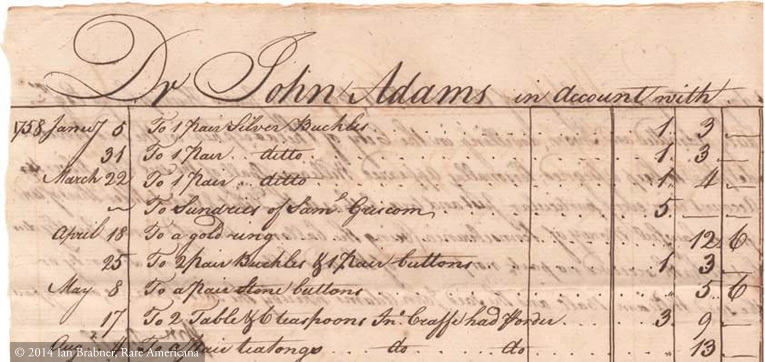
The year is 1758. The place is Philadelphia. John Adams (not the John Adams you might be thinking of) is having a legal dispute for silver buckles, gold rings, stone buttons, and handcrafted teaspoons. Early manuscript historical documents such as this example illustrate commerce, legal disputes, and social status in Colonial America.

Sometimes judging a manuscript notebook by its cover is the best thing to do. The upper board has an almost three dimensional quality. When we saw it we thought of looking at rows of seats in a movie theater. The spine has very modest tooling for decoration.
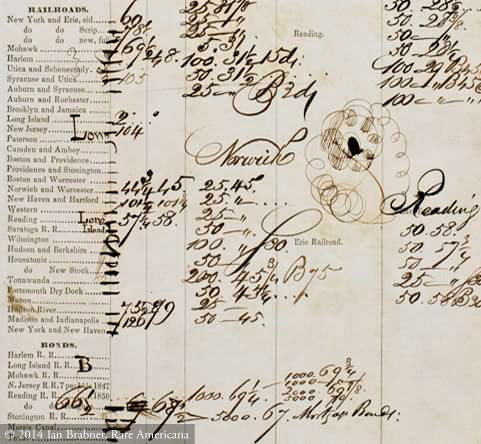
Image detail of a postal cancel of a handwritten letter loosely inserted inside a Swedish-American carpenter and cabinetmaker’s manuscript account book who lived in Chicago. Sometimes old letters and ephemera stay tucked away; keeping whole the history of the homely manuscript account book.
At the end of each day, the bookkeeper would then take all the raw data from the daybook and record it in a ledger book. The postings in the ledger book would keep track of all of the company’s individual accounts. This alphabetical listing of customers would show all the debits and credits that the company had and would help balance the accounts.
Further accounting of cash on hand, business expenses, the value of inventories and capital equipment and assets, the accounts payable and receivable, etc. would then provide important feedback to the merchant or manufacturer.

Fairly clean handwriting and a simple accounting system makes this manuscript account book easier to evaluate.
Business accounts or other summaries of assets, liabilities, equity, income, and expenses appear in other contexts. You may encounter such records in legal documents, investment reports, business prospectuses, or even in family correspondence.
18th century and 19th century manuscript account books might seem dry and uninteresting in the grand scheme of American history. These historical records, however, can be an important source for understanding how 18th century and 19th century Americans managed their affairs; how wider communities were affected by new goods and new technologies, how labor was compensated; and how land and capital were used.
To learn more about other types of manuscript material, read our post Autograph Manuscripts, Handwritten American History.